.jpg)
Ants are an integral component of terrestrial ecosystems. Formicarium is an artificial lodging structure made for ants in which we can keep them to observe and understand their social structure, activities, behavior etc. The formicarium is made of plaster of paris (PoP). Its internal design is patterned according to that ants make naturally and it is seen like a vertical cross section of the ant house in the ground. The door of formicarium remains the gateway for the ants. Inside this small house the small cavities are formed that are connected to the main entry road for ants to move inside and live in the cavities for some time. The visible side of the ant house is covered with a transparent material through which one can observe what is going on inside.
A formicarium (Ant House)
How to make a formicarium-
Take a rectangular box of cardboard or plastic having dimensions at least of 6 X 3 X 2 inches in length, width and height/depth respectively. Alternatively, you can take an empty box of sweet or chocolate box.
Take some wheat flour and make a bit tight dough of it and then make its shape having a long stem to which small balls are attached through small stalks in its length. The thickness of this shape should be lesser than the height/depth of the box in which it has to be placed. This shape should not be longer more than 3/4 length of the box.
1- After making of Ant House, place some food for ants, such as jaggary or sweet or grains, inside the cavities of the ant house.
2- Place the ant house in a corner at a shaded place.
3- Gradually, ants from nearby area will start reaching the ant house. Initially the ants will come, eat and move out. Each time you have to refill the food stuff so that the ants feel secured and prefer to settle in the cavities in course of time.
4- Once the ants are accommodated in it, start your observations of them.
5- At different time intervals observe and record the social structure, behaviour, feeding habit etc of ants. How they collaborate with each other to carry materials, how they manage different activities in collaborative manner, how each ant has a unique role, what sort of food materials ants prefer etc.
6- You can use formicarium to study ants during different seasons as well.
● Data collection and analysis -
● Record your observations systematically in a data format. An example of data table is given here; you can design your own data table according to the need.
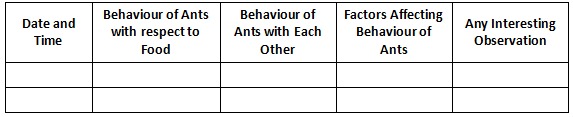
You can analyse your data quantitatively and qualitatively and make interpretations accordingly.
● Formicarium is an easy tool to observe and know about ants’ social structure and behavior.
● Ants do not feed upon any food and they also have food preference.
● We can protect ant diversity in our area by making such ant houses.
● How do ants maintain the temperature and air circulation inside their house?
● Do ants also sleep? Or whether they remain awake all times? What they do during night?
● Do ants also have day-night cycle of activities?
● Sometimes you see ants moving on a trail and do not deflect from the path, how do they manage it?
● Do ants smell? How do they find food material even from tightly packed bags?
● Do ants act as bioindicator? Give one example from which we know what they are indicating.
Diversity of Ants on the Earth-
There are more than 15700 species and subspecies of ants on the Earth. Ants make up 2/3rd of the biomass of all insects on the Earth. For more details you may see the following link-https://www.pnas.org/doi/full/10.1073/pnas.2201550119
Diversity and Endemism of Ants in India-
In India there are 828 known ant species from 100 genera. 256 (31%) of species are endemic to India (i.e. they are found only in certain parts of India and nowhere in the world). Whereas, 24 species are non-native (i.e. they are from other territories other than India). The endemism of ant species in India (31%) is much higher than endemic species of mammals (11%), fishes (8%), birds (4.3%) and flowering plants (10%). That means, one of every three ant species in India is endemic.
For more details about ant diversity in India you may see the following link – https://zookeys.pensoft.net/article/6767/


